Harrak
The Calamitous BobHarrak is the ruined capital of the Harrakan Empire, a city whose annihilation transformed the western part of Param into the Deadlands. It is the decisive geographical and historical center of the catastrophe: once the seat of an empire that terrified the world through unprecedented magical achievement, it became a cursed necropolis where undead creatures wander through the remains of imperial civilization and where Viviane Saint-Lys awakens in the emperor’s throne room with no usable explanation for her suffering.
Setting and Historical Place
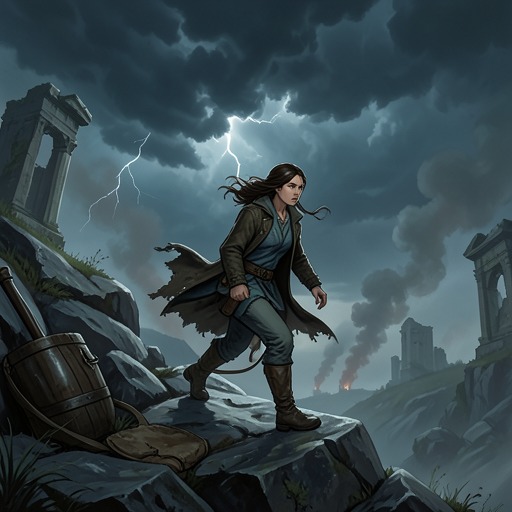
Harrak lies in the western part of Param, the large circular landmass on Niyl that is connected to its only neighbor by an isthmus no broader than a city. Param is fertile in general, but its western region bears the visible stigma of the greatest magical catastrophe ever recorded. From above, the scar resembles necrotic tissue on an otherwise healthy body: a vast valley enclosed by snow-capped mountain ranges, with only a small opening to the south. The land grows greener farther from the epicenter, while the center remains darkest.
The city was the capital and imperial seat of the Old Empire. Its elites reached heights of magical ability that no later civilization had matched, yet the same concentration of power produced their destruction. The Old Empire died at the apex of its power, leaving behind a cautionary landscape in which the legacy of its achievements survives mainly in private collections and the languages of kings. Harrak therefore functions not merely as a ruined city but as the exposed core of a civilization whose supremacy became inseparable from its collapse.
The Imperial Ziggurat and the Catastrophe
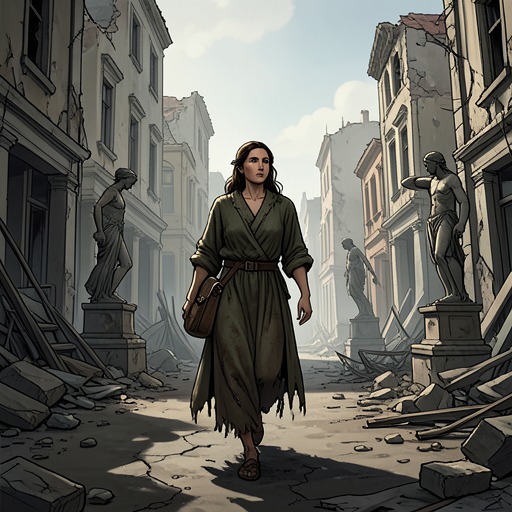
Only one expedition is known to have successfully explored the old capital. Its report described cursed streets dominated by the Imperial Ziggurat, a structure compared to the imposing corpse of an ancient drake. The building is less an intact monument than a gigantic cadaver: its interior was gutted by a cataclysmic explosion, while its surviving mass still overwhelms the surrounding city.
The scale of the destruction becomes clearest from the ziggurat’s summit. Harrak’s planned city extends for kilometers, with estates, temples, churches, and squares arranged with the exacting precision of a rigorous imperial capital. All of them are dark, empty, and devoid of movement. Beyond them lie basaltic sands, distant mountains, and rubble as large as apartment buildings. When the summit is viewed from within, the former apex has become a gigantic crater edged by molten, ragged vitrified stone. Its dimensions resemble an asteroid impact or a tactical nuclear strike, but the crucial fact is that the force came from inside the structure. Harrak’s central monument thus records an implosion rather than an ordinary external assault: the empire’s seat of power destroyed by the power it had concentrated within itself.
The Dead City and Its Survival Conditions
Only mindless undead tread Harrak’s sandy corpse. The city offers abundant buildings, yet those who have camped there deliberately avoid them, implying that Harrak receives no rain. Rain would cool a body quickly and make exposure unpleasant, while the abundance of available cover would make a magical rain-repellent shield unnecessary. The absence of rain is reinforced by the broader condition of the land: no dried grass, no visible renewable food source, and no practical means of sustaining life. Harrak is hostile not only because of its monsters but because its ecological system has been stripped of ordinary recovery.
The city’s danger is tied to black mana as well as to the undead. Near the southern gap in the surrounding mountains, the black-mana density finally begins to fade, and the plains become dotted with dark shrubbery rather than remaining uniformly saturated. Yet zombies still occupy those transitional spaces. Beyond the gap, a dense green forest offers the first unmistakable sign of living nature that Viviane Saint-Lys has seen in a long time. Harrak consequently stands at the center of a gradient: the dead imperial core gives way only slowly to plant life, forest, and a world capable of supporting ordinary existence.
Memory, Power, and Political Geography
Harrak’s identity is repeatedly reconstructed through imperfect survivors and later travelers. When Viviane Saint-Lys asks about the imperial family, she is told that a man was found quite dead in the pyramid’s throne room. When she asks what Harrak is, Solfis identifies it as the city in which they stand, the capital of the Harrakan Empire and the emperor’s seat. The exchange exposes the distance between official imperial language and present reality: the old formula still invokes the living emperor, while the city itself contains only corpses and remnants.
The ruined capital also remains a reference point in the political geography of Param. Baranese knights explain that Harrakan heartlands appear on their map with a small skull, while Baran lies far to the east and other countries occupy the intervening territory. Later information places Kazar within the local kingdom of Enoria, a former major power that split fifteen years earlier after a failed coup and a bloody two-year civil war. Harrak is therefore both a local destination on contemporary maps and the historical center from which the surrounding political order has been differentiated. Its imperial center has vanished, but its name still organizes how later kingdoms understand the continent.
The city’s influence reaches even into relations with peoples beyond the imperial human sphere. Marruk is identified as a female Kark who recently left what remained of her tribe, while the Kark are suffering through hardships partly caused by their own actions and partly by human actions. The Pure League, formed by northern free cities, is involved in the broader conflict, but the account distinguishes that conflict from a simple war between all humanity and the Kark. Harrak’s old imperial legacy thus persists in a world where former subjects, neighboring kingdoms, non-human peoples, and new alliances all negotiate the aftermath of older systems of domination.
Narrative Significance
Harrak establishes the book’s central contrast between extraordinary power and bare survival. Its planned avenues and monumental architecture testify to a civilization capable of reshaping the world; its crater, empty buildings, absent rain, and wandering undead show what remains when that power loses control. The city is at once archive, prison, and threshold. Viviane Saint-Lys awakens there in bodily and psychological agony, and escape becomes necessary because staying means death from monsters, thirst, hunger, and an environment incapable of replenishing life.
The southern opening gives Harrak a formal direction as well as a physical one. The surrounding mountains confine the city and the Deadlands, while the narrow route toward living forest becomes the path toward possible salvation. Even after travelers leave the deepest zone, the Deadlands remain in equilibrium: the many undead generate their own black field, and only several large-scale expeditions could reduce it significantly. No kingdom considers the land worth the decades of recovery that would follow. Harrak therefore survives as a self-maintaining imperial wound, abandoned by political powers but not released from history.
Against that permanence, the Cassian spring offers a different model of aftermath. Cassia the Unbroken’s death is remembered as an event after which the ground opened and a spring emerged, with waters still carrying the blessing of Neriad. The contrast is exact: Harrak converts magical achievement into a dead zone that reproduces its own corruption, while Cassia’s fulfilled life leaves behind water, blessing, and the possibility of renewal. In the wider architecture of the story, Harrak is the negative origin against which later living places are measured—a monument to power without restraint and the first landscape from which survival must be painfully reclaimed.